· Andre Sattler
Your Product Data Has Answers. Most of Your Team Can't Reach Them.
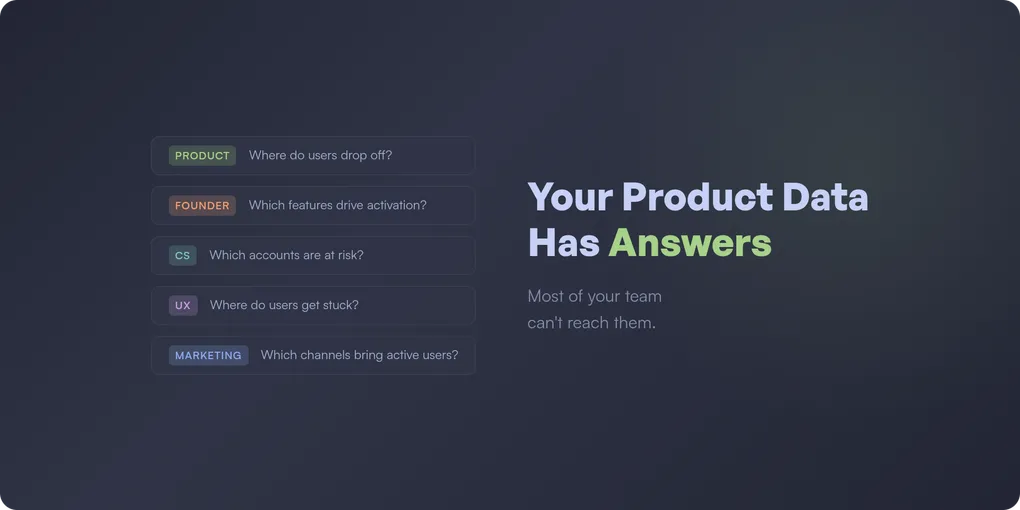
Your product is generating data every day. Every signup, every click, every session tells a story about how people use what you’ve built. The answers are in there — which features drive activation, where users get stuck, which accounts are thriving and which are fading.
But for most people on your team, that data might as well not exist.
The product lead has questions every week. The founder wants to know what’s working. CS needs to spot at-risk accounts. The designer wants to understand where users struggle. They all have legitimate questions — and the data to answer them is right there. They just can’t get to it.
The expertise gap
It’s not that your analytics tool is bad. It’s that getting value from it requires a specific set of skills that most team members don’t have — and shouldn’t need to have.
To get a useful insight out of a traditional analytics tool, someone needs to:
- Define and instrument events — write tracking code, name events consistently, attach the right properties. This is developer work.
- Build funnels, retention charts, and dashboards — decide which events to combine, in what order, with what conversion windows. This requires analytics expertise.
- Interpret the results — understand what “good” looks like, spot statistical noise, draw the right conclusions. This takes experience.
- Keep it all current — every time you ship a feature or change a flow, the tracking needs updating. This is ongoing maintenance.
In a B2B SaaS company with a dedicated data analyst, this works. Someone owns the pipeline, maintains the dashboards, and answers questions from the rest of the team.
But most small to medium-sized B2B SaaS teams don’t have that person. And without them, the gap between “we have data” and “we have answers” stays wide open.
Everyone has questions, few can answer them
Think about who on your team has product questions:
- Product leads want to know which features are actually being adopted and where users drop off
- Founders want a pulse on growth, activation, and whether the last release moved the needle
- CS teams need to know which accounts are healthy and which are slipping
- UX designers want to see where users get confused or stuck
- Marketing wants to understand which channels bring users that actually activate
Every one of these people could make better decisions with product data. The appetite is there. But building a funnel, configuring a retention analysis, or writing a custom query isn’t in their skillset. And it shouldn’t have to be.
So what happens? They either ask the one technical person who knows the tool — creating a bottleneck — or they make decisions based on intuition, customer complaints, and anecdotes. The data exists. It just doesn’t flow to the people who need it.
The event taxonomy treadmill
The standard advice is to invest upfront in a solid event taxonomy. Plan your tracking, define naming conventions, document everything.
This helps — but it doesn’t solve the core problem. Even with a perfect taxonomy:
- The product evolves faster than the tracking. You ship every week. The tracking plan gets updated occasionally, if at all.
- Different roles need different things. Product wants feature usage. CS wants account health. The founder wants growth metrics. One taxonomy rarely serves everyone well.
- Event design is genuinely hard. What’s the right event for “user completed onboarding”? When they finish the wizard? When they take their first real action? When they come back the next day? These decisions shape your metrics, and getting them wrong means your data tells the wrong story.
Even well-maintained event tracking only solves half the problem. You still need someone who can turn those events into insights — and that’s where most teams hit the wall.
What your team is missing
When product data only reaches a few people, the impact is quiet but real:
- Product decisions rely on opinion instead of evidence. Features get prioritized by who argues loudest, not by what the data shows.
- Churn signals go unnoticed. An account’s usage drops steadily over three weeks, but nobody sees it until the cancellation email arrives.
- Onboarding problems stay hidden. A significant portion of users drop off at a specific step, but without a properly configured funnel, nobody knows where or why.
- Growth opportunities pass by. A subset of accounts uses a feature in an unexpected way — a potential new use case — but it never surfaces because nobody thought to track it.
None of this is because people don’t care. It’s because the path from question to answer is too long and too technical for most of the team.
What if the tool met your team where they are?
The answer isn’t better event planning or more intuitive dashboard builders. It’s rethinking what an analytics tool should do in the first place.
What if it could:
- Understand your product automatically — observe how users actually move through your app, without anyone defining events
- Stay current on its own — keep up as you ship new features, rename pages, and change flows
- Answer questions directly — in plain language, so anyone on the team can ask and get a real answer
- Surface what matters proactively — flag at-risk accounts, identify drop-off points, and highlight patterns without waiting for someone to ask
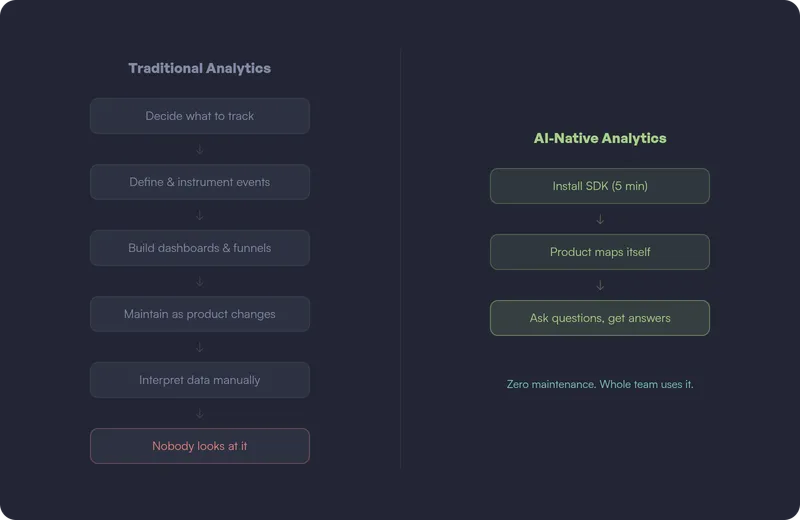
This is what modern AI makes possible — not as a layer on top of dashboards, but as a fundamentally different approach. When a system can observe product usage and build a structured understanding of your product, the whole event-tracking-to-dashboard pipeline becomes optional.
That’s what we’re building with Lunar Dinos. Product analytics where your whole team can get answers — not just the few people who know how to configure the tool. You can read more about why we started building this and how it works. If that resonates, join the waitlist.
— Andre