· Andre Sattler
Why We're Building Lunar Dinos
As a product engineer, what always drove me was seeing the impact of what I build. Who’s actually using the features I ship? What difference did that bugfix make? Did anyone even notice the improvement? That feedback loop — building something and then seeing it matter — is what makes the work meaningful.
But getting that feedback was never easy.
Seven years of the same pattern
About seven years ago, we used Google Analytics with tag managers. There was a dedicated person configuring the tracking side, and I’d send events from the code. It worked, sort of — but the gap between “I have a question about my product” and “I have an answer” was enormous.
The tools have gotten nicer since then. PostHog, Mixpanel, Amplitude — they’re easier to get into than the old Google Analytics + tag manager setup. But fundamentally, the workflow hasn’t changed: I still need to send events from the code, set up metrics and dashboards, understand funnels, retention, stickiness. All of that when often I just have a simple question I want an answer to.
What happened when we tried PostHog
Last year, as frontend lead, I had the task of finding and implementing a product analytics platform for our team. After some research I landed on PostHog — it was quite nice and had everything we thought we needed.
But it was repeatedly hard for different roles to get value from it. Hard to create or find the right metrics. Hard to know whether an auto-tracked event was actually correct for what someone wanted, or whether I as a developer would need to integrate a custom event. Product managers and UX designers struggled. And for marketing, customer support, and sales — who regularly had product questions of their own — the barrier was even higher.
If this sounds familiar, you’re not alone.
I also looked at June, which I quite liked. They had a simplicity-first approach with good B2B-focused opinionated defaults — things like account-level dashboards out of the box. Sadly, they were shut down and acquired by Amplitude. But their philosophy stuck with me.
AI on top of complexity is still complexity
Now I see PostHog and others bringing AI into their platforms. But to me it feels like another layer on top of everything. These AI tools instrument the already complex platforms — they help you create graphs and answer questions based on those graphs. But in the end, the AI doesn’t know what your product actually is. It doesn’t know your market. It doesn’t know your customers. It’s just a better interface to the same underlying complexity.
That felt backwards to me. If you have AI that can understand product data, why still require manually defined events? Why still need configured insights? Why should getting an answer require a data team?
What Lunar Dinos does differently
That’s how the idea for Lunar Dinos came about: an AI-guided product analytics platform that deeply integrates knowledge about your B2B SaaS product. Instead of bolting AI onto dashboards, we use today’s AI to learn and observe your product, your features, your market, and how users actually behave — while keeping parts of June’s philosophy of doing B2B SaaS analytics in a simple, opinionated way.
Setup takes five minutes. You install a lightweight SDK — one component wrapping your app. From there, Lunar Dinos records sessions and starts learning. No manual event tracking needed.
The AI learns your product
This is where it gets interesting. Instead of you telling the tool what your product does, Lunar Dinos figures it out by observing real usage. It runs a discovery process and builds up a deep understanding of your product — automatically.
It discovers your product graph — a structured map of all your pages, modals, and how users navigate between them.
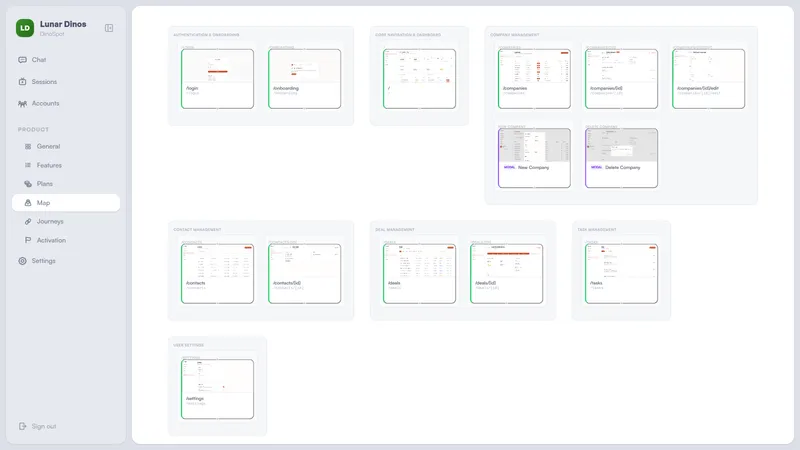
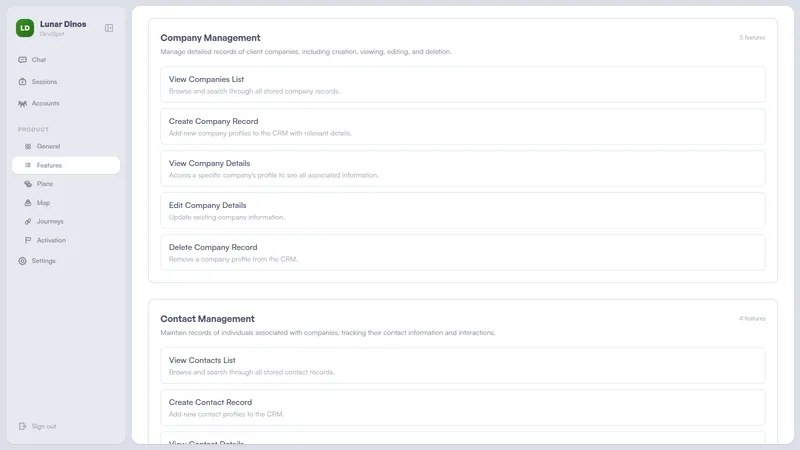
It identifies your features — grouped by product area, with descriptions, all derived from what users actually do. No one had to define “Company Management” or “Contact Management” as features — the AI recognized them from usage patterns.
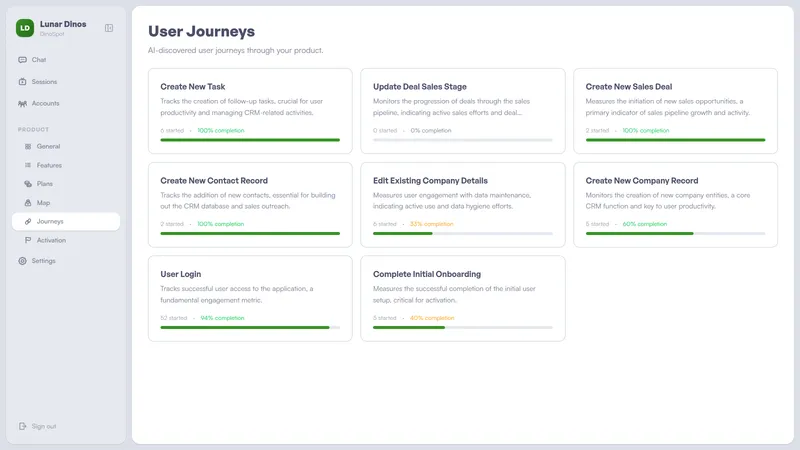
It maps out user journeys — the key flows through your product, with completion rates and drop-off points. “Create New Task”, “Complete Initial Onboarding”, “User Login” — all discovered, all tracked, no configuration needed.
And it defines activation milestones — an opinionated, B2B-focused funnel from sign-up to full activation. The AI identifies what “Setup”, “Aha moment”, and “Activated” actually mean for your specific product, with descriptions that explain why each milestone matters.
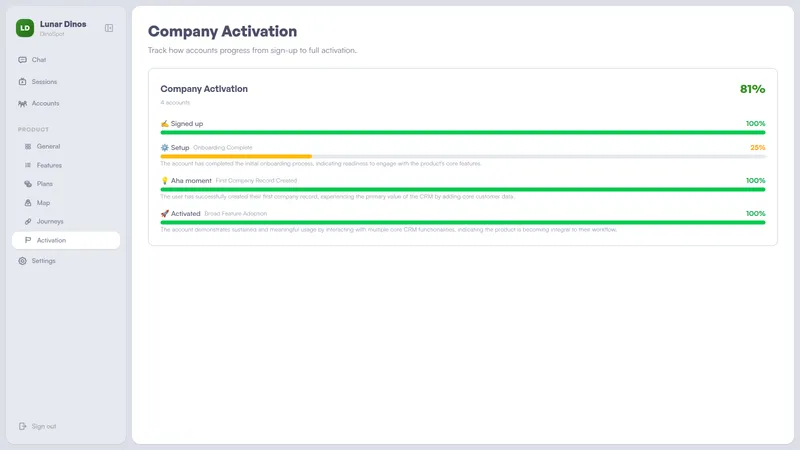
This is the foundation. Because the AI actually understands your product — not just raw events — everything else becomes possible.
Ask anything, get real answers
Anyone on the team can ask questions in plain English. The AI doesn’t just query a database — it reasons about your product, your users, and your data together.
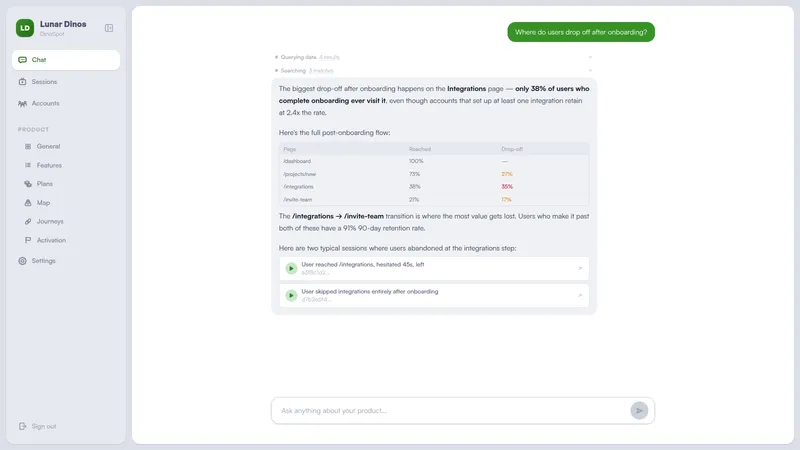
“Where do users drop off after onboarding?” — and you get an actual answer. Not a chart you need to interpret, but a breakdown of what’s happening at each step, why it matters, and links to real sessions where you can see users struggling.
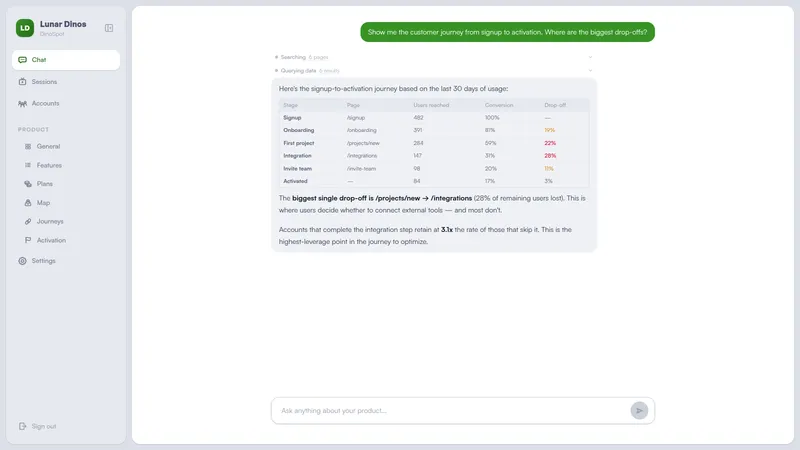
“Show me the customer journey from signup to activation” — and Lunar Dinos maps out every stage with conversion rates, identifies the biggest drop-off points, and tells you where to focus.
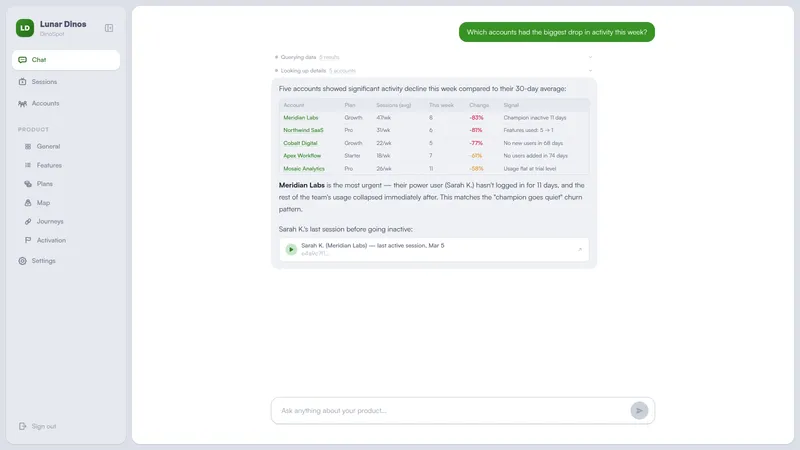
“Which accounts had the biggest drop in activity this week?” — and you see exactly which accounts are at risk, what changed, and what pattern it matches. It even links to the last session of a key user so you can see what happened. This is the kind of question a CS team asks every week — and now they can get the answer themselves.
See everything about an account in one place
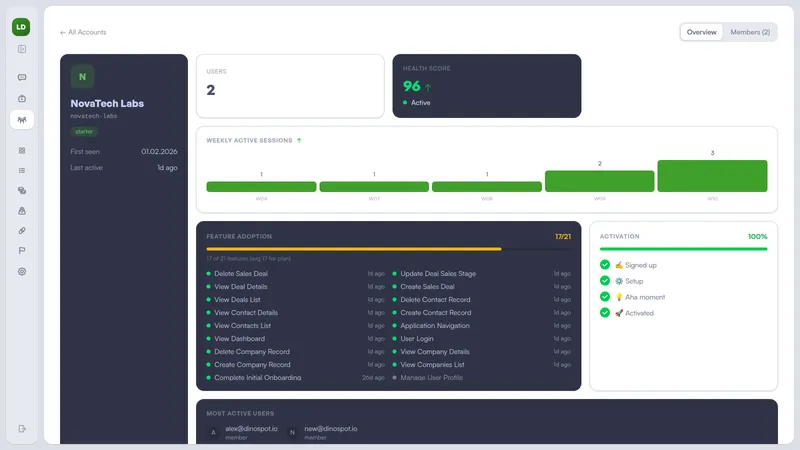
Every account gets its own page — health score, feature adoption, activation progress, weekly session trends, and the most active users. At a glance you know if an account is healthy, what they’ve adopted, and where they are in their activation journey. CS and sales can self-serve without asking anyone to build a dashboard. This is where June’s B2B philosophy lives on — accounts are first-class citizens, not an afterthought.
No event taxonomies to define. No insights to configure. No training required. Product, founders, CS, marketing, sales — everyone can use it from day one. You can track the full customer journey and detect churn signals without building custom tracking for each.
What’s next
We’re currently in early access, working with a small group of B2B SaaS teams to refine the product. If you’re tired of analytics tools that nobody on your team actually uses, join the waitlist or book a demo.
— Andre